February 3rd is Setsubun: People throw beans and eat the number of beans equal to their age.

The characters for Setsubun hint at its meaning, the turning point of a season, and according to Japan’s old calendar, this day marks the end of winter.
People through beans together

On this day, people scatter dried soy beans both outside and inside their homes shouting “Evil out and fortune in!” People then eat the number of beans equal to their age (sometimes an extra bean too) in order to ward of evil.
Long ago, it was believed that evil presented itself at the turning point of a season, and the throwing of beans began as a way to chase away such evil.
When Setsubun draws near, many supermarkets set up corners selling Setsubun related goods. There, beans are sold as fukumame which means good luck beans.
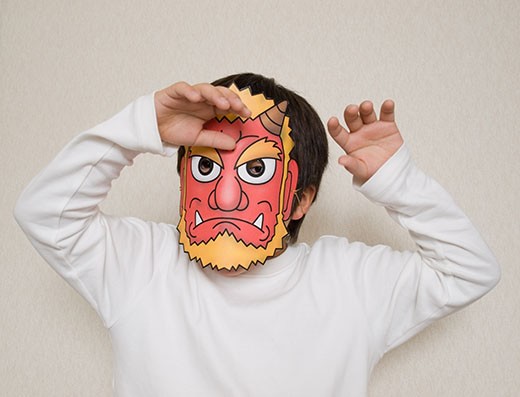
The beans often come with an ogre’s mask printed on card, and fathers put on the masks and play the roles of ogres helping make the bean throwing an exciting activity.
In Osaka, people also eat Ehomaki.

Ehomaki are sushi rolls eaten in the evening on Setsubun. People eat them in silence facing the auspicious direction of the new year while making a wish.
On Setsubun, sushi restaurants in Osaka sell take-out ehomaki, and many people eat them facing the auspicious direction of the new year.
In recent years, this tradition has spread throughout Japan, and ehomaki are sold and eaten in many different areas.
On Setsubun, many of Japan’s shrines and temples also carry out bean throwing rituals.
If you happen to be in Japan for Setsubun, please join in the fun and throw some beans, too!